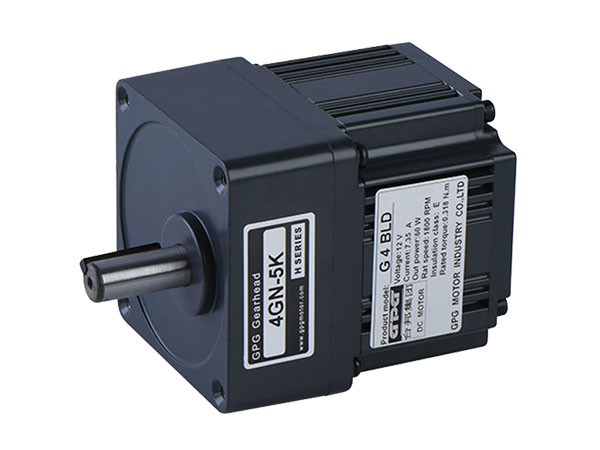
Views: 0 Author: Site Editor Publish Time: 2026-09-10 Origin: Site


How do car factories lift massive vehicle chassis so effortlessly? Standard electric motors simply lack the low-end torque required for such heavy tasks. An AC gear motor solves this mechanical hurdle by effectively multiplying power. In this guide, we break down its fundamental applications in automotive engineering. We will also share practical insights on equipment selection from an engineer's front-line perspective.
AC gear motors act as critical mechanical bridge components. They convert high-speed, low-torque motor rotation into the controlled, high-torque output demanded by automotive manufacturing.
The primary industrial applications include heavy-duty assembly line conveyors, internal powertrains for Electric Vehicles (EVs), and automated testing equipment like dynamometers.
Integrating a precisely specified speed reducer improves overall energy efficiency and ensures system longevity. It also delivers the operational precision necessary for robotic assembly.
Selecting the correct structural configuration remains vital for maintaining alignment in high-vibration environments. Horizontal foot-mounted designs are particularly effective here.
Before examining specific use cases on the factory floor, we must grasp the foundational mechanics of power transmission. The automotive sector demands machinery capable of operating continuously under extreme physical stress. Consequently, raw electrical power is virtually useless without precise mechanical refinement.
At its core, an AC gear motor is a unified piece of machinery. It seamlessly couples an alternating current electric motor with a mechanical gear train. When AC flows through the stator, it generates a rotating magnetic field that spins the rotor at high speeds—often between 1,500 and 3,600 revolutions per minute (RPM). However, this raw velocity is wildly impractical for lifting a 2,000-pound engine block.
Forcing a standard direct-drive motor to move a heavy load at low speeds causes a massive amp draw. This inevitably leads to rapid overheating and stator burnout. To harness this energy safely, the integrated gearbox intercepts the high-speed rotation. Through a series of interlocking gears, the reducer steps down the RPM.
According to the principles of mechanical physics, as rotational speed decreases, output torque increases proportionally. For instance, an industrial-grade Gear Reducer Motor typically offers power outputs ranging from 100W up to 3700W, with reduction ratios spanning from 1:3 all the way down to 1:1800. This torque multiplication empowers a relatively compact motor to move massive loads with exceptional control.
The most visible application of gear reducers is found within the manufacturing facilities themselves. Modern automotive assembly lines are marvels of continuous motion. They rely entirely on robust power transmission networks to maintain strict production quotas.
From the initial stamping press to the final inspection station, a vehicle frame travels miles along various conveyor systems. Overhead chain conveyors and floor-mounted slat belts require immense starting torque. They must overcome the static friction of moving dozens of steel car bodies simultaneously.
In practice, integrating a robust gear motor provides this necessary force while ensuring smooth acceleration. Specifically, certain gear configurations offer inherent self-locking properties. In the event of a sudden power failure on an inclined conveyor, the mechanical resistance of the gearbox prevents heavy vehicle frames from rolling backward. This acts as a critical fail-safe, protecting both expensive machinery and factory personnel.
Beyond moving heavy parts from point A to point B, automotive manufacturing dictates exact positioning. Robotic arms utilized for spot welding, automated painting, and intricate parts assembly rely on servo-driven gear motors with exceptionally low backlash.
While heavy conveyors use standard industrial gearboxes, robotic automation employs highly precise reducers. This ensures a welding arm stops at the exact millimeter required, hundreds of times per hour. Without this mechanical precision, panel gaps would be uneven, welds would miss their targets, and the vehicle's structural integrity would be compromised.
While industrial gearboxes build the cars, a completely different class of mechanical reducers is actively transforming how modern vehicles drive. The global transition from internal combustion engines to electric propulsion has shifted automotive engineering toward highly efficient, compact power transmission.
Unlike traditional gas engines that idle, electric traction motors deliver maximum torque instantly from zero RPM. Yet, these electric motors spin at incredible velocities, frequently exceeding 15,000 RPM. If an EV's motor were connected directly to the wheels, the vehicle would theoretically possess a top speed of hundreds of miles per hour. Unfortunately, it would completely lack the torque required to accelerate the heavy, battery-laden chassis from a standstill.
To resolve this physics problem, nearly all modern electric vehicles utilize a single-speed gear reducer integrated directly into the drivetrain. This unit steps down the high-speed motor rotation to a manageable wheel speed, massively boosting the torque delivered to the axles. This process provides the seamless acceleration EVs are known for while keeping the motor in its most energy-efficient range.
The third fundamental application bridges the gap between material handling and quality assurance. As automotive plants adopt more flexible logistics, specialized gear motor solutions have become indispensable.
Industry data reveals a massive shift toward modular micro-logistics in auto plants. Plant managers are actively moving away from rigid conveyor lines toward dynamic fleets of Automated Guided Vehicles (AGVs). These autonomous robotic carts navigate the factory floor, transporting heavy sub-assemblies—such as battery packs or completed drivetrains—directly to specific assembly stations.
Because AGVs are battery-operated and must maneuver through tight aisles, they rely on highly efficient gear setups for their drive wheels. The mechanical advantage allows the AGV to carry payloads weighing several tons while moving smoothly. Furthermore, the efficiency of the AC gear motor directly impacts the cart's battery life, dictating how long it can operate before requiring a recharge.
Before any newly manufactured vehicle leaves the factory, it undergoes rigorous performance testing. Automotive dynamometers (dynos) are massive testing rigs used to measure engine horsepower, electric motor efficiency, and braking forces.
These testing facilities use heavy-duty gear reducers to simulate real-world road resistance. By applying controlled mechanical loads against the vehicle's drivetrain, engineers accurately measure output and verify safety specifications. The gearboxes in these environments must withstand extreme stress, high temperatures, and continuous variable loads without introducing measurement errors.
For procurement managers and plant engineers, selecting the right power transmission equipment is a major operational decision. Relying on standard electric motors without mechanical speed reduction leads to massive system inefficiencies. What happens when you integrate the right gear motor? The advantages become objectively clear.
Performance Metric | Standard Direct-Drive AC Motor | Integrated AC Gear Motor |
|---|---|---|
Low-Speed Torque | Very Poor (Prone to stalling under load) | Excellent (Multiplied exponentially by gear ratio) |
Energy Efficiency | Low (Draws excessive amps when strained) | High (Motor runs at optimal RPM, gearbox does the work) |
Heat Generation | High (High risk of stator coil burnout) | Low (Mechanical advantage reduces electrical strain) |
Industrial Lifespan | Short (Due to constant overload) | 10-15+ Years (With standard maintenance protocols) |
This mechanical advantage minimizes wasted electrical energy. Modern premium reducers operate with mechanical efficiencies exceeding 95%. By matching a properly sized motor to the specific load requirements, facilities can significantly lower their carbon footprint and realize substantial cost savings over the equipment's lifecycle.
Selecting the appropriate mechanical power transmission equipment requires more than just looking at horsepower. A mismatched motor causes premature equipment failure, stalled conveyors, and severe production bottlenecks. Let's look at actionable selection criteria used by front-line engineers.
The physical orientation of the motor dictates its stability within the larger mechanical system. Flange-mounted units bolt directly onto the driven machine's housing, saving space in tight applications like robotic arms.
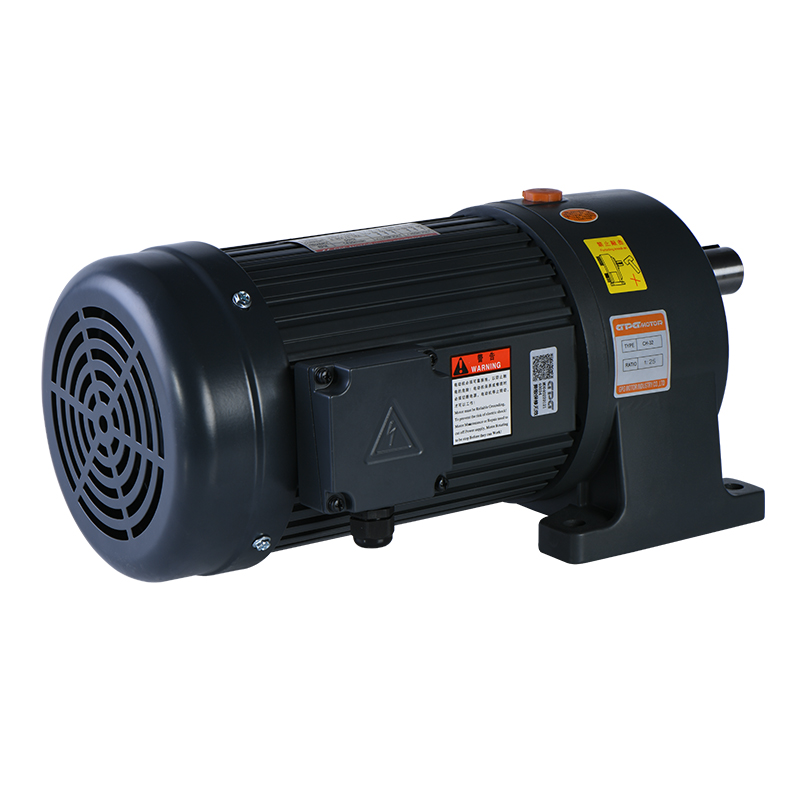
In contrast, heavy-duty material handling demands a solid base. Specifying a Horizontal Foot-Mounted Small Gear Reducer Motor (such as industry-standard CH series models) ensures maximum base stability. Featuring pre-drilled solid bases, these units prevent structural flexing and maintain precise shaft alignment under continuous industrial loads.
Beyond physical mounting, internal specifications must align with the application's physics. Engineers utilize a systematic approach to sizing:
Calculate Required Torque: The gearbox must handle both the continuous running torque and the peak starting inertia. Remember, starting inertia can spike up to 300% higher than the running load.
Determine the Gear Ratio: This dictates the final output speed. For automotive conveyors, ratios typically range between 1:30 and 1:200 depending on the required line pace.
Apply a Service Factor: An automotive plant operating 24/7 with frequent start-stop cycles requires a motor with a high service factor (typically 1.5 or higher) to ensure longevity.
Check Voltage & Phase: Ensure the motor matches factory power grids, commonly utilizing 3-phase 220V/380V configurations for industrial stability.
As the automotive sector transitions toward Industry 4.0, raw mechanical power is no longer enough. The global push for EV manufacturing is forcing legacy plants to retool completely, driving a demand for highly intelligent components.
We are witnessing the rapid rise of "Smart" AC gear motors. Next-generation equipment incorporates embedded Internet of Things (IoT) sensors directly into the aluminum or cast-iron casing. These sensors continuously monitor critical metrics, such as microscopic vibration changes (indicating bearing wear) and thermal spikes in the lubrication oil.
Consequently, predictive maintenance is becoming the industry standard. Advanced algorithms analyze these continuous data streams to predict exactly when a component will fail. This allows maintenance teams to schedule targeted repairs during planned downtimes, effectively eliminating catastrophic, multi-million-dollar halts in production.
A standard AC motor is designed to provide high-speed rotation, typically ranging from 1,500 to 3,600 RPM, but it delivers relatively low torque. This makes it unsuitable for moving heavy industrial loads directly. An AC gear motor combines a standard motor with an integrated mechanical gearbox. This reducer steps down the rotational speed while significantly multiplying the torque output, making it the standard choice for heavy automotive applications.
The electric motors utilized in modern EVs are engineered to spin at incredibly high speeds, often exceeding 15,000 RPM, to maximize efficiency. Connecting this high-speed output directly to a vehicle's wheels is mechanically impossible for safe driving. A gear reducer acts as the transmission, stepping down the high RPMs to a manageable wheel speed while simultaneously multiplying the torque, which gives EVs their characteristic rapid acceleration.
While it varies based on the specific station, overhead chain conveyors and floor slat belts in auto plants typically utilize gear ratios ranging from 1:60 to 1:200. These high reduction ratios are necessary to drop the standard motor speed (e.g., 1,750 RPM) down to a very slow, safe creeping speed (often under 20 RPM at the output shaft) while generating massive pushing force.
Backlash refers to the slight mechanical play or clearance between mating gear teeth. In robotic welding or painting, high backlash causes the robotic arm to vibrate or stop a few millimeters off-target. To ensure perfect panel gaps and precise spot welds, auto plants use specialized low-backlash or zero-backlash gear reducers (like servo-driven planetary gears) that guarantee exact, repeatable positioning.
The operational lifespan depends heavily on correct initial sizing, the operating environment, and adherence to maintenance protocols. When engineers accurately calculate load capacities and apply the correct service factor, a premium gear motor can reliably operate for 10 to 15 years. Achieving this longevity requires routine visual inspections and adherence to specified lubrication schedules.
Horizontal foot-mounted configurations are primarily utilized in applications that require a highly stable, flat mounting surface to manage heavy loads and continuous vibration. In the automotive sector, they are the standard choice for powering main assembly line conveyor belts, heavy material handling lifts, and large-scale quality control testing equipment.
Gear reducers are the unsung heroes of modern automotive manufacturing. From powering the heavy-duty conveyor belts that assemble the chassis to providing the necessary torque inside the drivetrains of the latest electric vehicles, these mechanical devices are indispensable. By understanding the physics of torque multiplication and carefully evaluating mounting designs and load capacities, plant engineers can drastically improve production efficiency.
Are you upgrading your assembly line or designing new automated factory equipment? Choosing the right power transmission component is critical to avoiding costly downtime. Explore the full range of high-performance Gear Reducer Motors at GPG Motors to find the exact specifications, ratios, and mounting configurations your project demands.